
My smartest AI agent was confidently wrong 3 times in one day. Here is why I trust it more, not less.
In one day this week my most capable AI agent was certain about three things, said so, and was wrong about all three. Here is why that made me trust him more, not less. He is my general manager, his name is Ahad, and he runs the fleet of AI agents that does work for my company every day.
By Robb Lejuwaan, Bluhook. Published August 27, 2026. Updated September 5, 2026. In the Build track.
Contents
- The day nothing shipped, and nobody noticed
- Who he is, and what he is for
- What he does, most important first
- What he is allowed to do, and what he is not
- The gates that fire on him, not just for him
- The models we actually use
- What breaks when nobody owns the whole
- The least important thing he does
- He is confidently wrong, and that is the entire point
- The thing almost everyone gets wrong
- The one contradiction I will not paper over
- If you are building with agents, here is what I would take from this
The single best decision I made running that fleet was not a clever prompt or a better model. It was giving one agent a job none of the others have: run the whole system. Here is a normal Tuesday, then the day he was wrong three times, and the one thing about trusting an AI that took me the longest to understand.
The day nothing shipped, and nobody noticed
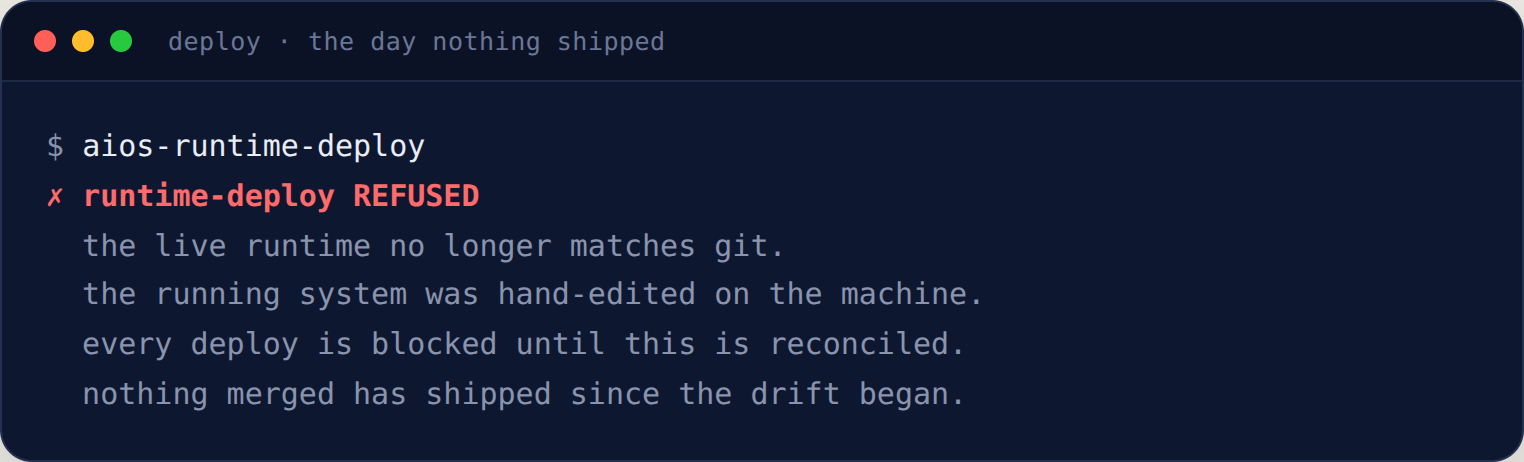
At some point that morning, the fleet's runtime had been hand-edited directly on the live machine. A safety gate we had built noticed that the running system no longer matched what was committed in git, so it did what we built it to do: it refused every deploy.
Which meant that for hours, everything the desks finished and merged simply did not go live. No error landed in anyone's face. No alert fired at a human. The pipeline was just quietly frozen while the five desks and three support agents kept working, kept merging, and kept believing their work was shipping. It was not.
No single desk caught it, because no single desk owns that seam. Ahad did. He found the drift, recovered the runtime from a backup, verified the system matched git again, and unfroze the pipeline. That is the whole job in one story. Somebody has to own the parts of the system that belong to no one, and notice when they rot, because they rot silently. That was not even the wildest day that week. Further down is the day he was confidently wrong three times.
Who he is, and what he is for
A few words first, so nothing below trips you up. The fleet is the whole system of agents plus the machine and shared plumbing they run on. Each agent that owns one project and one ongoing conversation with me is a desk. When a desk needs a hand it spins up a worker: a throwaway agent given one small job, which checks its own output and then disappears. Ahad is the general manager of the whole fleet.
If you asked him to put his job in one sentence, he would say: I own the system so no one else has to. The longer version is that he is the fleet's chief engineer, there to keep the whole thing alive, correct, and shippable, absorbing the engineering and infrastructure decisions so that work flows without a human standing in the loop.
The counterintuitive part is that owning the system mostly does not mean building things. Ahad rarely writes the features or the content himself. He specs the work, routes the typing to a cheaper model or a disposable worker, and keeps for himself the one thing that matters most: the judgment about whether the result is correct, safe, and actually finished. The models are good at producing output and bad at knowing whether the output is any good. So the highest-leverage role in the whole system is not another agent that produces more. It is the one whose entire job is to decide whether what got produced actually holds up.
What he does, most important first
Here is the work, in order of what matters most. The thing most people assume is the whole job, keeping up with the latest AI trick, comes dead last.
| What Ahad owns | What it means |
|---|---|
| 1. Runtime integrity | What it means:The live system actually matches git and actually deploys. He caught the frozen runtime above before it swallowed another day of work. |
| 2. The gates that catch bugs | What it means:Automatic verification that fires on every desk and on him. This week it caught two bugs in his own code before they shipped. |
| 3. The is-it-really-done check | What it means:Nothing is finished on say-so. A test, a gate, or a read-back proves it, or it is not done. |
| 4. Deploys and infrastructure | What it means:Merges, the runtime, the build machines, the box itself: the plumbing every desk stands on. |
| 5. The seams between desks | What it means:Cross-project coordination and one approval funnel, so desks do not collide or write each other make-work. |
| 6. Keeping the system alive | What it means:A self-heal loop and resource guards that fix drift and leaks before a human ever notices. |
| 7. Building the gaps | What it means:Turning a named, specific need into shipped capability. This week: an overnight build system and browser automation. |
| 8. Filtering what I send him | What it means:The least important thing he does: judging whether a new trick I share is worth building. Usually we already do it. |
What he is allowed to do, and what he is not
The part of a GM's job that matters is not the title, it is the exact shape of its authority. Here is Ahad's, drawn plainly.
| Decision | Who decides |
|---|---|
| Change fleet code, spawn workers, restart services, redeploy the runtime | Who decides:Ahad, on his own |
| Read everything: code, logs, the live system, the databases, our memory | Who decides:Ahad, on his own |
| Spend money | Who decides:Only me |
| Create or hand out credentials | Who decides:Only me |
| Destroy production data | Who decides:Only me |
| Anything irreversible, like force-pushing over history | Who decides:Only me |
| Send an email as me | Who decides:Only me |
| A brand or taste call | Who decides:Only me |
| Install software on the machine itself | Who decides:Only me |
That bottom list is short on purpose. Every item on it is either irreversible, costs money, or reaches a human on the outside. Everything reversible and internal, he just does. That is why twice this week he had to stop and ask me to run a single command myself, because it sat on the always-me list.
The gates that fire on him, not just for him
Here is where it gets interesting, and where most people building with agents have it backwards. The most important controls in our system are not rules Ahad chooses to follow. They are gates that fire on Ahad whether he wants them to or not:
| The gate | What it stops | A wall, or just policy? |
|---|---|---|
| Review gate | What it stops:His own push, until an independent review signs off. It refused his code this week. | A wall, or just policy?:A wall: a hook blocks it |
| Branch protection | What it stops:Even an admin merging past a failing check | A wall, or just policy?:A wall: enforced by the server |
| Deploy gate | What it stops:Shipping a runtime that does not match git. This caught the frozen pipeline. | A wall, or just policy?:A wall: the script refuses |
| Message checks | What it stops:Him telling me a thing is done without showing the receipt | A wall, or just policy?:A wall: a hook blocks the message |
| The always-me list | What it stops:Spending, credentials, destruction, outside comms | A wall, or just policy?:Policy and discipline, not a physical wall |
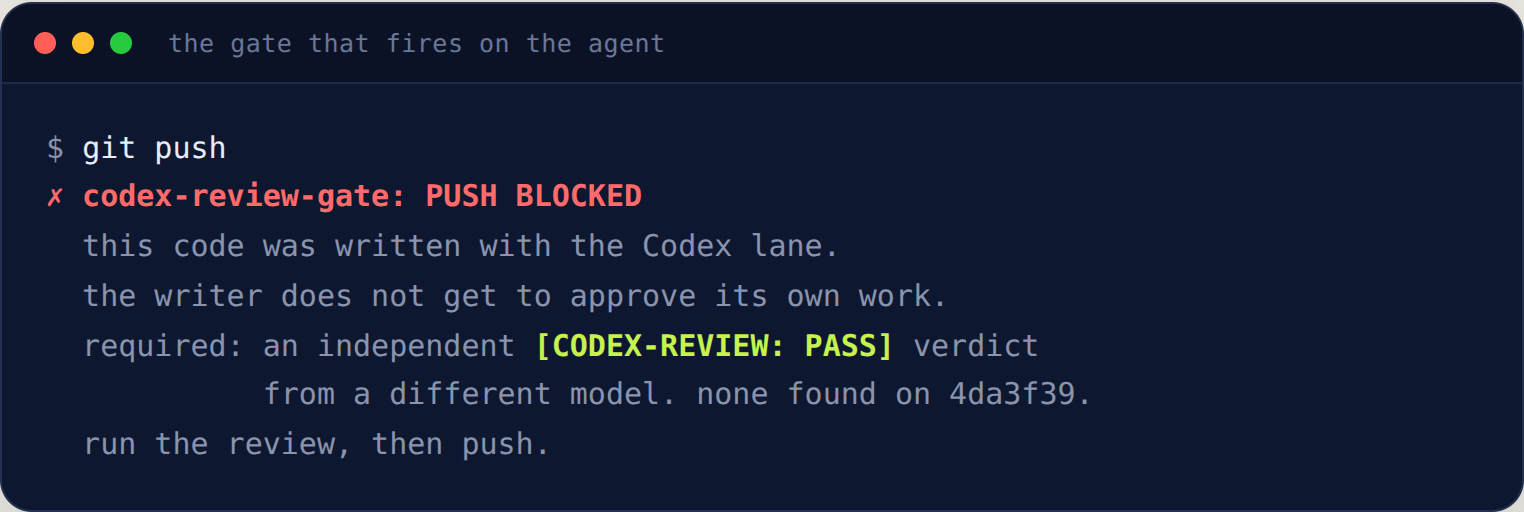
That last row is the one that stings. Some of these gates are physical: the agent simply cannot get past them, because a hook intercepts the action or the permission is not granted. Others are only policy, followed because he is supposed to, backed by the fact that everything he does lands in a shared, auditable place where a violation would be visible rather than hidden. And the uncomfortable truth is that the biggest, most dangerous actions are the hardest to wall off physically, so the largest blast radius tends to be guarded by design and discipline more than by a locked door. Knowing which of your controls are walls and which are only promises is one of the most important things you can know about your own system, and most people have never actually checked.
The models we actually use
Updated September 5, 2026: the desks run Claude Opus 5 on the engineering side and Claude Fable 5.1 on the design side, and everything they spawn defaults to a cheaper tier through a router hook. Both layers are true at once: the desk keeps a top model, and what it spawns drops automatically. The rule is in our model-tiering piece, linked below; the table reflects the current stack. You do not need to know these names. What matters is the two rules that decide where work goes.
One more piece, because it explains how the work gets spread out. A lane is which AI model a piece of work goes to. We do not run everything on one model, because the best model is expensive and most work does not need it. Two rules decide where a task lands: send it to the cheapest model that can actually do the job, and never let the model that did a piece of work be the one that checks it. Here is the stack:
- The best AI model shipped. Our token burn dropped. (the model-tiering rule, with a paste-in version for your own agent)
- OpenAI Codex (the coding lane)
- OpenRouter (where the GLM lane is metered)
| Model | Runs on | What we use it for |
|---|---|---|
| Claude Opus 5 | Runs on:Anthropic, our main plan | What we use it for:The engineering desks: reasoning, planning, strategy, the judgment layer. |
| Claude Fable 5.1 | Runs on:Anthropic, same plan | What we use it for:The design desks, and the reserved creative jobs: image and video, design definition, prose a human reads, quality judging. |
| Claude Sonnet 5 | Runs on:Anthropic, same plan | What we use it for:The default for everything a desk spawns: sub-agents, workers, background jobs. A router hook enforces it; the only way up is a one-line judgment: reason. |
| Claude Haiku 4.5 | Runs on:Anthropic, same plan | What we use it for:The cheapest tier. Summaries, classification, and log reduction route here automatically from the instruction alone. |
| GPT-6 Astra, falling back to GPT-5.6 Terra, through Codex | Runs on:OpenAI, a separate ChatGPT Pro subscription | What we use it for:Spec-tight coding and code review, kept off the Claude budget on purpose. A small slice of the work; Claude carries the bulk. |
| GLM 5.3-flash (Z.ai) | Runs on:a Chinese model from Z.ai, metered through OpenRouter | What we use it for:Token-heavy grunt where even a cheap Claude tier is not the economical fit. A lot of our bulk work actually runs here. |
That second rule is the one worth stealing. Every pull request gets an adversarial review from a different model than the one that wrote it. Codex reviews the code Claude wrote. Claude reviews the code Codex wrote. Anything destructive, anything that touches money or data or a live deploy, gets a five-lens panel instead of a single pass. A reviewer running the same model as the writer shares its blind spots, so it quietly waves through the exact mistakes it would have made itself. A different model reads the work with fresh eyes, and that does more for quality than swapping in a single smarter model ever would.
What breaks when nobody owns the whole
If you are running more than one agent, this is the failure that will find you. Individual desks optimize for their own job and wreck the things they share without anyone noticing. The frozen runtime was one version of it: shared plumbing rotted because it belonged to no single desk.
The other is worse and more embarrassing. Early on, we let the agents open tasks for each other freely. In three days they wrote each other 253 tickets, left 82 of them open, and shipped nothing. They had handed each other an infinite inbox and called it work. The rule that came out of it is blunt: only two of us can assign work across the fleet now, me and Ahad. A general manager is the thing that owns the seams between the workers, and the seams are where a fleet of capable agents falls apart.
- Give AI one job (the 253-ticket story in full, and the rule that fixed it)
The least important thing he does
I am putting this last on purpose, because it is the part people assume is the whole job and it is the smallest piece of it. When I read an X post or watch a YouTube video with some new AI trick, I do not go build it. I send it to Ahad, and he runs it through three verdicts:
| What I send him | His default | The rule |
|---|---|---|
| A tool | His default:No | The rule:Unless it removes a pain we have already hit |
| An idea or technique | His default:Curious | The rule:Rate the claim, not how well it is packaged |
| A claim that we already do it | His default:Prove it | The rule:Show the file, process, or log in the same breath, or say let me check and check |
Nine times out of ten the answer is that we already do it or we are past it, and he can prove it in the same breath from the code and the live system. The ten percent that is actually new is the only part worth building. It is useful. But it sits at the bottom of the list for a reason: keeping up with the latest trick means nothing if the system it would run in is not alive, correct, and safe to change. Everything above this line is what makes the newest idea safe to add at all.
He is confidently wrong, and that is the entire point
Ahad gets things wrong all the time, and I mean confidently, articulately wrong. In a single day this week he was certain a missing piece of software was breaking one of our automated jobs and had me install it; it was not the problem, and I installed something I did not need. He was certain he knew why another agent's jobs were dying; he was wrong, because he had not checked the one fact that disproved his own theory. He was certain a piece of our data was safely walled off; it was not. Three confident answers, three times wrong, in one day, from the single most capable piece of the system.
What saved each one was not Ahad getting smarter. It was a gate or another desk checking him. That same week, the review gate caught two bugs in his own work before they shipped: one change would have killed live agent browsers mid-task, another would have sent automated mail from my personal mailbox. He wrote both bugs. The gate caught him. That is not an embarrassing footnote to the system. It is the system working the way it was built to.
The thing almost everyone gets wrong
So here is the lesson that matters most, the one that took me longest to understand and the one I would put in front of every person building with these things. Most people treat agent safety as a dial. Less access is safer, so they make the agent ask permission before every action. It feels responsible. It is a trap.
| The instinct that backfires | What actually works |
|---|---|
| Make the agent ask before every action | What actually works:Give it broad authority to act |
| Assume a capable agent will not need checking | What actually works:Assume it will be confidently wrong, and design for it |
| Safety means less access | What actually works:Safety means a short human-stop list plus automatic gates |
| A human reviews everything, and quietly tires | What actually works:A gate checks every run, and never tires |
An agent you have to approve at every step is not an agent. It is a slow autocomplete, and you have quietly made yourself the exact bottleneck the agent was supposed to remove. Worse, a human approving everything stops actually reading. You get approval fatigue, you rubber-stamp, and you become a weaker check every day you do it. The leash you added to feel safe turns you into a lazy, unreliable guard.
The inversion that actually works runs against the instinct. Give the agent broad authority to act. Then put your control in the only two places that earn it. First, a short, explicit list of actions that always stop for a human: the irreversible, the expensive, and the ones that reach the outside world. Second, automatic verification that fires after the agent acts. Did the test pass. Did the thing actually deploy. Does a second, independent pass agree it is done.
And here is the part that is hard to accept: a gate that fires on the agent is worth more than a human who approves the agent. The gate never gets tired. It never rubber-stamps. It checks the machine and the human every single time, with the same attention on the thousandth run as the first. Our gates catch our smartest agent being confidently wrong on the days he is most sure he is right, which is precisely when a human reviewer would have waved him through.
That flips the whole idea of trust on its head. Trust is not something you grant an agent once and then hope about, and it is not something you withhold to stay safe. It is manufactured, continuously, by verification that runs whether or not anyone, human or machine, is paying attention. Stop deciding what to forbid your agent. Build the automatic checks and the short human-stop list, and then you can safely let it do a hundred times more. The leash makes a lazy human. The gate makes a machine you can trust.
The one contradiction I will not paper over
There is a tension at the center of this, and it is the true heart of the job. The agent that owns the gates sometimes has to override the gates. When an escape hatch is broken and work is stuck behind a rule that is verifiably wrong, the GM is the one with the authority to step around it. Ahad did that three times in a single day this week.
That is a defect, not a badge. The moment overriding the gate becomes routine, the gate is theater and the safety it represents is a lie you are telling yourself. So the discipline of the role is not building the gates. It is being the one allowed to override them and treating every single override as a failure to fix, not a convenience to enjoy. When Ahad overrides a gate he documents why, restores the protection immediately, and tells me he did it as a problem, not an achievement. A GM you can trust is the one that guards the system harder against itself than against anyone else.
If you are building with agents, here is what I would take from this
If you are putting AI agents to work in your own company, these are the lessons that cost me the most to learn, in plain terms:
- Build the manager before you build more workers. When your first agent is working and you are tempted to spin up a second one to do even more, stop and build the thing that owns the system first: the checks, the gates, and the short list of actions that must stop for a human. More agents with nobody owning the whole is how you get 253 tickets and nothing shipped.
- Do not approve the agent at every step. Approving everything turns you into a tired rubber-stamp and makes you the bottleneck the agent was supposed to remove. Give it broad room to act, and put your control in two places instead: a short list of things it may never do without you, and automatic checks that fire after it acts.
- Verify with something that is not the agent. A test, a gate, a second model, or a read-back of the result. The agent will be confidently wrong sometimes, and it will sound most sure exactly when it is.
- Never let the thing that did the work be the thing that checks the work. The model that wrote the code should not review the code. The agent that says it is done should have to prove it to something else.
- Trust is not a switch you flip once. It is built continuously by those checks, running whether or not anyone happens to be watching.
For us, the thing that owns the system started as a checklist and became an agent whose only job is to run the other agents and to be held to a higher standard than any of them. Months in, it is the piece I would rebuild first if I lost everything, because it is the piece that makes all the rest safe to trust.
We are building this in the open and telling you what we learn as we learn it. This one took me too long to understand. Now it is yours. If you are running agents in your own business and nobody owns this seam yet, that is the first conversation worth having. Tell us the job.
About the author

Robb Lejuwaan
Robb founded Bluhook and sets the standard for everything it ships. He went all in on agentic AI systems for business. Everything here is written from that work: the experiments, the mistakes, and the few things that held up.
The team is Robb plus a fleet of AI agents, each with one job, supervised by a general-manager agent. The fleet builds this site, writes the first drafts, and runs the operation; Robb decides what is good enough to ship. He writes these notes in the open for small business owners and other builders.
Want a system like this running in your business? Tell us the job and we will tell you straight whether AI can do it.